Smali vs Java
The First Question which may come to your mind is:
- If the Apps are made in Java then what is this smali, and why is it important ?
Well The answer to is quite simple:
- Computers have limitations in understanding numerical values beyond the decimal system (base-10). To represent values greater than 9, they use hexadecimal values (a, b, c, d, etc.) and binary numbers (0s and 1s).
- This implies that computers cannot fully comprehend our number system, and vice versa. We must learn their number systems to bridge this gap.
- While we can learn how computers operate, it is impractical to expect computers to learn our number system.
- Similarly, when we use Java to develop Android applications, the Android system needs to convert the Java code into a format it can understand, known as Smali. This conversion ensures that the Android system can interpret and execute the Java code properly.
Smali is important because it allows developers, reverse engineers and malware analysts to:
- Reverse engineer Android applications
- Modify Android applications
- Create malicious applications
- Identify malicious applications
What is Smali?
- Smali is a low-level language that is similar to Java bytecode. It is designed to be easy to read and understand, and it can be used to create and modify Android applications. Smali is also used by malware authors to create malicious applications.
- Stands for “assembler” in Icelandic.
- Everything in it are similar to Java (from start import to methods, classes, etc.), only representation of those things are changed nothing else
What is Baksmali?
- Stands for “disassembler” in Icelandic.
- Also named after the village of Dalvik, as it is the opposite operation of assembling (Smali).
What is Dalvik Virtual Machine (DVM)?
- The Dalvik Virtual Machine (DVM) is an android virtual machine optimized for mobile devices. It optimizes the virtual machine for memory, battery life and performance.
- Named after the village of Dalvik in Iceland, where the Dalvik Virtual Machine was created. It was written by Dan Bornstein. Read More
- The DVM is responsible to run Android applications. The DVM is responsible for executing the instructions contained in Smali code. When an Android application is installed on a device, the DVM converts the Smali code into a format that the device’s processor can understand. This process is known as “dexing”.
Connection to the Dalvik Virtual Machine with Smali
The DVM converts Smali code into a format that the device’s processor can understand through the process known as “dexing”.
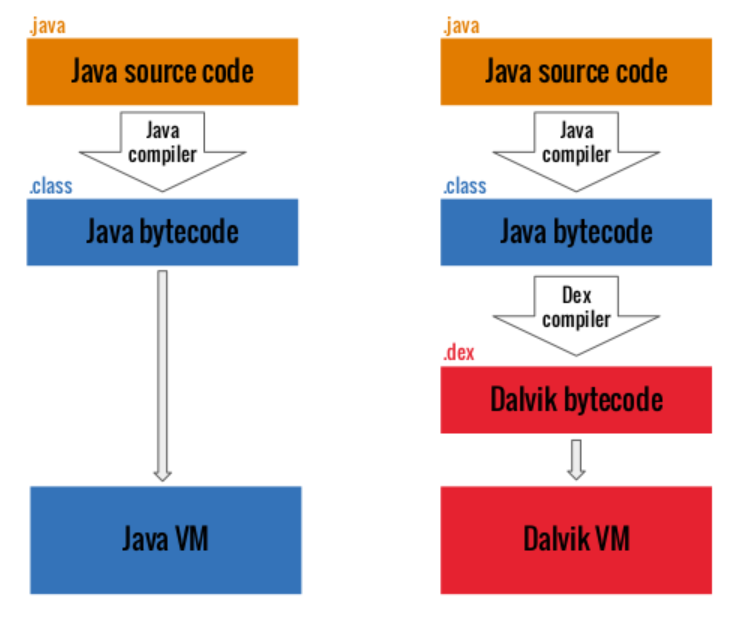
Let’s take an example and try to understand
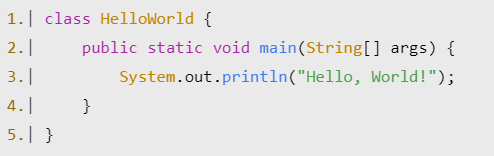
Since everybody takes example of Hello World! in this field, let’s go with that
- In Java:
- In Smali:
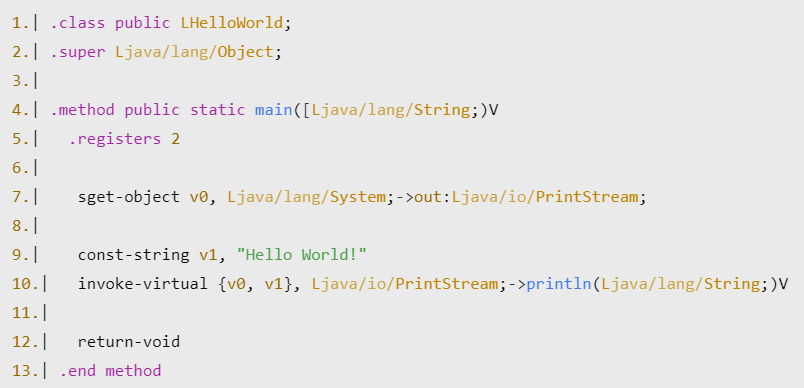
Now let’s Understand this
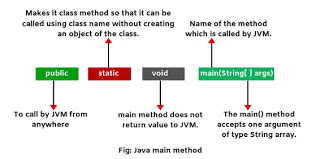
- Line 1: In Java, you can simply write
class HelloWorld `{your code}`
However, in smali you must add a capital “L” before the class name, like.class public **L**HelloWorld `{your code}`. Note that there is ’.’ too just before ‘class’ defining, this is basic syntanx for each method/class/return defining in smali.
The next line in smali: [Ljava.lang.Object; is the name for Object[].class and .super doing function like calling/storing of it
- Line 2:
.super Ljava/lang/Object;
declares that the current class extends the Java class Object.
When you create a new class in Java, it automatically extends the Java class Object. This means that your new class inherits all the methods and variables that are defined in the Object class.
A simple way to understand this concept is a family tree. In a family tree, everyone is related to each other. Similarly, in Java, all classes are related to the Object class.
For example, let’s say you have a class called Car. The Car class inherits all the methods and variables that are defined in the Object class. This means that you can use methods like toString(), equals(), and hashCode() on any Car object.
Another way to think about it is that the Object class is the parent class of all other classes in Java. When you create a new class, you are essentially saying that your new class is a child of the Object class.
- Parent Class:
Vehicle - Child Class:
Car
The Car class inherits all the properties and methods of the Vehicle class. This means that a Car object has all the same properties and methods as a Vehicle object, such as make, model, and year.
In the same way, all Java classes extend the Object class, which means that they inherit all the properties and methods of the Object class.
- Line 4:
.method public static main([Ljava/lang/String;)V
declares a public static method named main that takes an array of String objects as input and returns void.
In this case/example the main method is like the front door of your house. When someone wants to enter your house, they come through the front door. Similarly, when you run a Java program, the JVM enters your program through the main method.
Another way is to think of the main method as the starting point of a race. When a race begins, all the runners start at the same starting line. Similarly, when you run a Java program, the JVM starts executing your program at the main method.
- Line 5:
.registers 2
specifies that the method uses two registers. More information on Day 3 wiki
- Line 7:
sget-object v0, Ljava/lang/System;->out:Ljava/io/PrintStream;
retrieves the PrintStream object associated with the standard output stream and stores it in register v0.
- Line 9:
const-string v1, "Hello World!"
loads the string “Hello World!” into register v1.
- Line 10:
invoke-virtual `{v0, v1}`, Ljava/io/PrintStream;->println(Ljava/lang/String;)V
calls the println method on the PrintStream object in register v0, passing the string in register v1 as an argument. This prints the string “Hello World!” to the standard output stream.
- Line 12:
return-void
returns from the main method.
- Line 13:
.end method
marks the end of the method.
Class Header
Okay, so we looked at a full example. Now, let’s zoom in on the very top of a smali file. Think of it like the title and introduction of a book – it tells you some important things about what you’re about to read! This top part is called the Class Header.
Imagine the Class Header is like a little information card for the class. It always has a couple of important pieces of information, and sometimes it has a few extra details.
Here are the important things you’ll find in the Class Header:
.class: (Must-have!) We learned this before. It tells you what the class is called (like a name tag!)..super: (Must-have!) We learned this too. This is like saying “This class is a type of…” It tells you what “parent” class this class comes from (like saying “a dog is a type of animal”)..source: (Nice to have, but not always there!) This tells you the name of the original.javafile that thissmalicode came from. It’s like saying “This recipe came from Grandma’s cookbook.”.implements: (Sometimes there!) This tells you if the class follows specific “rules” or promises to do certain things. Imagine it’s like a scout promising to be helpful and kind.
- This directive is used to specify that the current class implements one or more interfaces. When a class implements an interface, it must provide concrete implementations for all the methods declared in the interface. Example: In Java, you can write:
package com.example;

class ExampleClass implements MyInterface {
    // Class implementation
}
In Smali, this would be represented as:
.class public Lcom/example/ExampleClass;
.super Ljava/lang/Object;
.source "ExampleClass.java"

.implements Lcom/example/MyInterface;
.debug: (Rare to see!)- This directive is used to enable or disable debugging information for the class. When debugging information is enabled, the Smali code will include additional information that can be useful for debugging purposes. It’s practical implementation is hardly seen in the wild.
Annotations
Annotations in Smali are similar to annotations in Java. They provide metadata about the class, method, or field, such as its visibility or whether it is deprecated.
They are declared using the .annotation directive, followed by the annotation’s visibility (e.g., runtime, system, build) and the annotation’s type descriptor and any associated elements. The annotation block is terminated by the .end annotation directive.
Here are some examples of annotations in Smali:
.class public Lcom/example/ExampleClass;
.super Ljava/lang/Object;

.annotation runtime Ljava/lang/Deprecated;
.end annotation

.annotation system Ldalvik/annotation/EnclosingClass;
  value = Lcom/example/OuterClass;
.end annotation

.annotation system Ldalvik/annotation/InnerClass;
  accessFlags = 0x0002
  name = "ExampleClass"
  outer = Lcom/example/OuterClass;
.end annotation

# class definition and methods go here
In this example:
@Deprecated: This is a runtime annotation (indicated byruntime) with the descriptorLjava/lang/Deprecated;. It signifies that theExampleClassis deprecated and should no longer be used.@EnclosingClass: This is a system annotation (indicated bysystem) with the descriptorLdalvik/annotation/EnclosingClass;. Thevalueelement specifies thatExampleClassis enclosed within theLcom/example/OuterClass;.@InnerClass: This is another system annotation with the descriptorLdalvik/annotation/InnerClass;. It indicates thatExampleClassis an inner class. The annotation includes elements specifying theaccessFlags(here,0x0002, indicating it’s a private inner class, you can read more about access flags at https://jakewharton.github.io/dalvik-dx/docs/latest/com/android/dx/rop/code/AccessFlags.html), thenameof the inner class (“ExampleClass”), and theouterclass (Lcom/example/OuterClass;).
public static final Parcelable.Creator<j> CREATOR = new i(0);
The equivalent Smali code with an annotation for the field’s generic signature would look like:
.field public static final CREATOR:Landroid/os/Parcelable$Creator;

  .annotation system Ldalvik/annotation/Signature;
    value = {
      "Landroid/os/Parcelable$Creator<",
      "LC1/j;",
      ">;"
    }
  .end annotation

.end field
Here, the @Signature annotation (Ldalvik/annotation/Signature;) specifies that the CREATOR field is a Parcelable.Creator parameterized with the type C1/j. This preserves the generic type information from the original Java code.
Annotation visibility:
system: This annotation is visible to the virtual machine but not to the Java code.runtime: This annotation is visible to the Java code at runtime and can be accessed using reflection.build: This annotation is used during the build process and is not visible at runtime.
Fields
Fields in Smali are defined using the .field directive within a class. Each field has a name, type, access modifiers and optionally an initial value. The syntax for defining a field is as follows:
.field [access_flags] field_name:field_type [= initial_value]
Where:
access_flags: Optional access modifiers (e.g.,public,private,static, etc.).field_name: The name of the field.field_type: The type of the field (e.g.,Ifor integer,Ljava/lang/String;for a string, etc.).initial_value: Optional initial value for the field.
Example:
.field public static final myField:I = 42
.field private myString:Ljava/lang/String; = "Hello, Smali!"
.field public myBoolean:Z
here, myField is a public static final integer field i.e, it can be accessed from anywhere, is a constant and is of type integer with an initial value of 42. myString is a private field of type string with an initial value of “Hello, Smali!”. myBoolean is a public field of type boolean with no initial value specified.
*Access Modifiers: Access modifiers in Smali are used to control the visibility and accessibility of fields and methods. The common access modifiers are:
public: The field or method is accessible from any other class.private: The field or method is accessible only within the class it is defined in.protected: The field or method is accessible within the class and its subclasses.static: The field or method belongs to the class itself rather than to instances of the class.final: The field is a constant and cannot be changed after initialization.volatile: The field is volatile and changes to it are immediately visible to other threads.transient: The field is not serialized when the object is serialized.synthetic: The field is generated by the compiler and is not explicitly defined in the source code.enum: The field is an enumeration type.abstract: The method is abstract and must be implemented by subclasses.native: The method is implemented in native code (e.g., C/C++).
Methods
Methods in Smali are defined using the .method directive. The syntax for defining a method is as follows:
.method [access_flags] method_name([parameter_types])return_type
    .registers number_of_registers

    # method body goes here
.end method
Where:
access_flags: Optional access modifiers (e.g.,public,private,static, etc.).method_name: The name of the method.parameter_types: A list of parameter types enclosed in parentheses. Each type is represented by its Smali descriptor (e.g.,Ifor integer,Ljava/lang/String;for a string, etc.).return_type: The return type of the method, represented by its Smali descriptor (e.g.,Vfor void,Ifor integer,Ljava/lang/String;for a string, etc.). Example:
.method public static myMethod(I)Ljava/lang/String;
    .registers 2

    const-string v0, "Hello, Smali!"

    return-object v0
.end method
In this example, myMethod is a public static method that takes an integer parameter and returns a string. The method uses two registers (v0 and v1) to store intermediate values. It creates a string “Hello, Smali!” and returns it.
Type Descriptors
Type descriptors in Smali are used to represent the types of fields, method parameters and return values. They are similar to Java type descriptors but have a specific syntax. Here are some common type descriptors:
| Descriptor | Type | Value Example (human-readable) | Size in Bytes |
|---|---|---|---|
V | Void | - | 0 |
Z | Boolean | true/false | 1 |
B | Byte | -128 to 127 | 1 |
S | Short | -32,768 to 32,767 | 2 |
C | Character | 'a', 'b', etc. | 2 |
I | Integer | -2,147,483,648 to 2,147,483,647 | 4 |
F | Float | 1.4E-45 to 3.4028235E38 | 4 |
J | Long | -9,223,372,036,854,775,808 to 9,223,372,036,854,775,807 | 8 |
D | Double | 4.9E-324 to 1.7976931348623157E308 | 8 |
[ | Array (reference type) | [I (array of integers), [Ljava/lang/String; (array of strings) | - |
L<class_name>; | Object (reference type) | Ljava/lang/String; (String object), Lcom/example/MyClass; (custom class) | - |
[!NOTE] Unless stated otherwise, all type descriptors are case-sensitive. For example,
Iis an integer, whileiis not a valid type descriptor. Similarly, unless stated otherwise, all type descriptors in the above table are primitive type whileL<class_name>;is not a primitive type but a reference type.